Learn · The sky
The signs and the stars
The signs begin at the spring equinox, not at the stars they are named for. Over two thousand years the two have drifted about a sign apart.
Which sign is your Sun in? See your chart, free, and see the stars behind it.
When the zodiac was set down, a little over two thousand years ago, each sign lay roughly over the stars it was named for. The Sun in Aries stood among the stars of the Ram, and the Sun in Leo among the stars of the Lion. But the signs were never counted from the stars. They were counted from the seasons: Aries begins where the Sun stands on the first day of spring in the northern hemisphere, and each sign after it runs thirty degrees further along the Sun’s path.
Why the two parted
The Earth’s axis turns slowly, as the axis of a spinning top does, and takes about twenty-six thousand years to go round once. As it turns, the point where the Sun crosses the equator in spring slides west against the stars, about a degree in a lifetime. The signs move with that point, because they are measured from it. The stars stay where they are. Over two thousand years the slide has come to most of a sign, so each sign now lies about a sign west of the constellation that gave it its name. The sign of Leo, for one, ends at Regulus, the bright star at the Lion’s heart, and runs west from there, most of it under the stars of Cancer.
Which one your chart uses
Western astrology counts the signs from the equinox. This is the tropical zodiac, and it is the one every chart on this site is cast in. When your chart says your Sun is in Gemini, it means the Sun stood in the thirty degrees the seasons call Gemini at the minute you were born, whatever stars lay behind it. Vedic astrology counts from the stars instead. That is the sidereal zodiac, and it places most people’s Sun, Moon and planets one sign earlier. The two are consistent ways of reading the same sky, measured from different starting points.
The constellations are not equal
The signs are twelve equal parts because they measure the year. The constellations are the shapes the stars make, and along the Sun’s path they are far from equal: the stars of Virgo cover more than forty degrees of it and the stars of Scorpius fewer than ten. A thirteenth constellation, Ophiuchus, the serpent-bearer, lies across the Sun’s path between Scorpius and Sagittarius. It has no sign, because the signs were always twelve parts of the year and never a list of the stars.
How the skies here show it
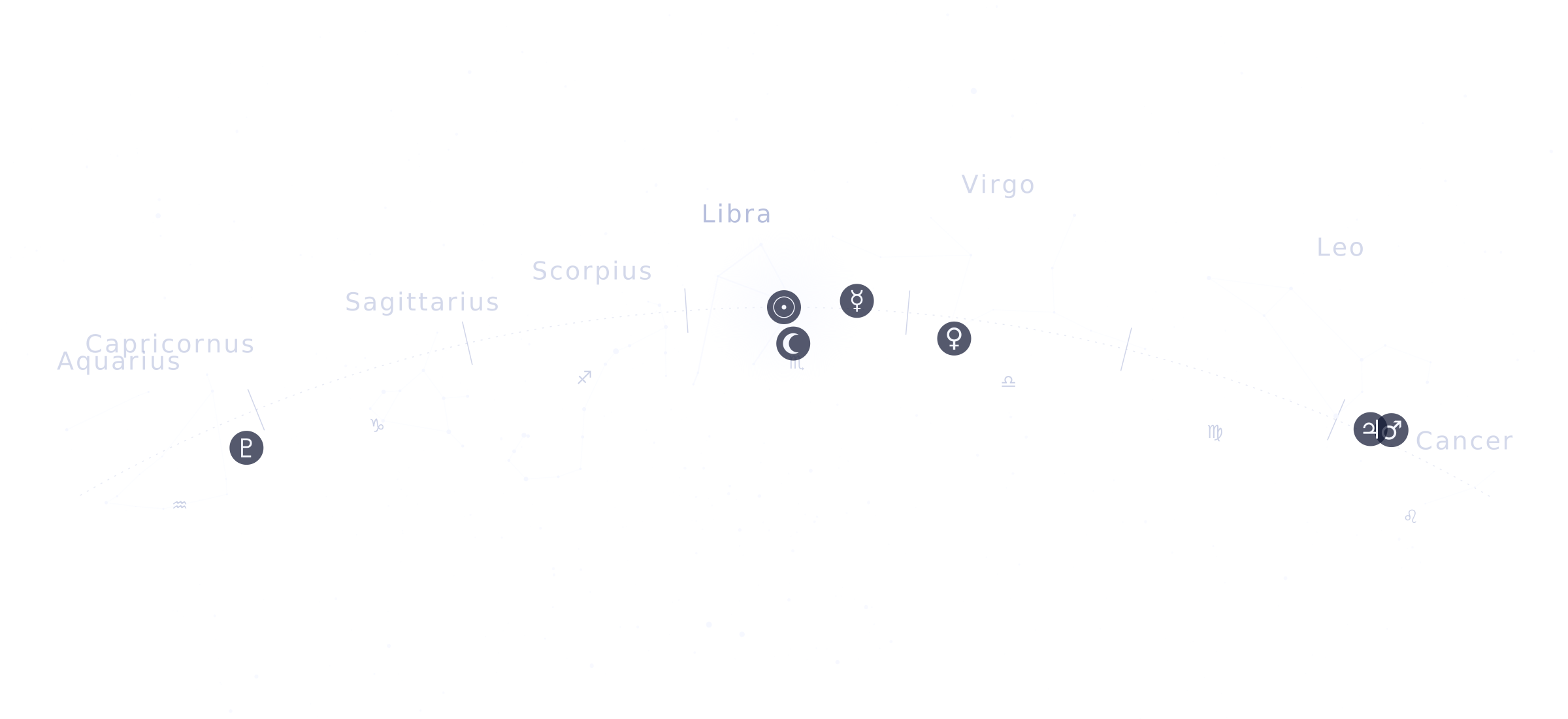
The skies on this site draw both as they stand: the constellations as their real stars, and the signs where your chart counts them. Point at a constellation, or tap one, and the sign that carries its name lights too, a little to the west. Point at a sign and its stars light. On the band of tonight’s zodiac below, you are facing south, so west is on the right.
How the analysis treats it
Your analysis names every placement by its sign and its degree in the tropical zodiac, the Sun and Moon and every planet alike. The sky drawn for the moment you were born shows the stars behind every one of them that was above the horizon, so you can see both at once: where your chart counts a planet, and the stars it was shining among.