Mercury and Saturn aspects
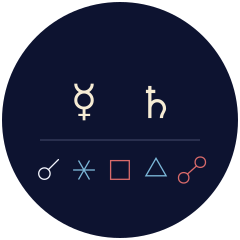
Mercury and Saturn in aspect describe how careful, serious and structured your mind is. Together, in step or at odds, they set how you learn, how you speak and how much you doubt your own ideas.
You check the email three times before sending it, and you still notice the typo afterwards.
Mercury is your mind and voice; Saturn is discipline, time and caution. An aspect between them gives your thinking weight, and the angle says whether it makes you precise or simply slow to trust your own voice.
Mercury conjunct Saturn
You think carefully and speak deliberately. You are logical, thorough and serious, and you prefer facts to guesses. A conjunction like this makes learning slow at first and lasting once it sticks.
Mercury trine or sextile Saturn
Your mind is organised and practical. You concentrate well, plan ahead and explain things clearly, and people trust what you say. Expertise comes with time. The trine makes discipline second nature; the sextile builds it with practice.
Mercury square or opposite Saturn
Self-doubt silences you. You fear sounding foolish, freeze in exams or keep your best ideas to yourself. The square sets a harsh critic in your head; the opposition puts critics across from you. Over the years you outgrow the fear and keep the care, and your words carry an authority only slow thinking earns.
How common is each?
Over the years the two meet in all five, some more often than others.
| Aspect | How common |
|---|---|
| Mercury conjunct Saturn | about one birth in 20 |
| Mercury sextile Saturn | about one birth in seventeen |
| Mercury square Saturn | about one birth in thirteen |
| Mercury trine Saturn | about one birth in fourteen |
| Mercury opposite Saturn | about one birth in 25 |
Measured every six hours from 1920 to 2030: the share of births whose chart shows each aspect between them, within the orbs every chart here is cast with.
Find your own aspects
Your chart is free and takes a moment: the wheel, your Sun, Moon and rising sign, and every aspect between your planets, with how close each one is.